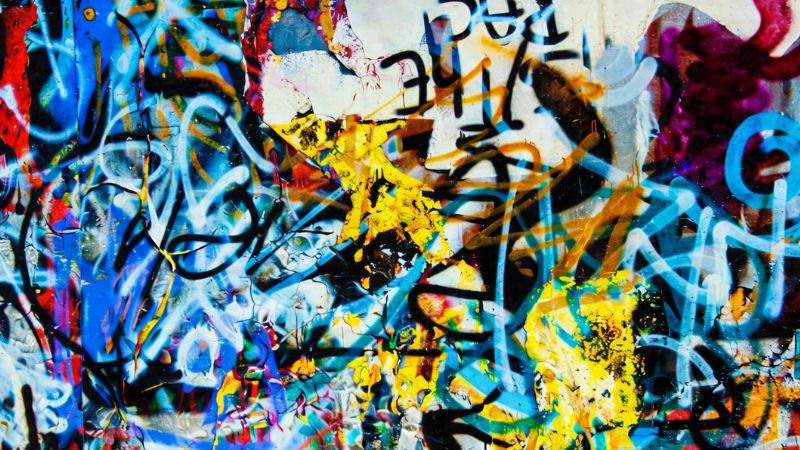
In March 2017, when Priyageetha Dia, 25, turned the staircase on the 20th storey of her Housing Board block in Jalan Rajah in Balestier from grey to gold, residents and Dr Lily Neo, the MP for Jalan Besar GRC, praised Priyageetha’s intention of dedicating a local art piece and public comments of valuing her artwork flooded online. Back in 2013, street artist Samantha Lo was sentenced to 240 hours of community service after a run-in with the law the year before, when she was caught stenciling “My Grandfather Road” on roads and pasting her stickers on traffic light buttons. One would question the difference in reactions from the public in Singapore. This raises debates similar to Banksy art Singapore and the difference between graffiti art, street art and street murals which can sometimes be viewed as vandalism Singapore.
The spotlight on vandalism as an offence in Singapore has even sparked an international debate, dating back to the 1994 conviction of 18-year-old American citizen Michael P. Fay for vandalizing cars using spray paint, and the sentence of six strokes of the cane imposed on him. And who could forget Swiss national Oliver Fricker in 2010 who pleaded guilty to charges of trespassing into a MassRapid Transit depot and spray-painting a train with an accomplice? Fricker was sentenced to five months’ jail and three strokes of the cane. On appeal, the High Court increased his total jail term to seven months. Such cases highlight how graffiti art and street art are often connected with vandalism Singapore unlike the appreciation of Banksy art Singapore.
What Exactly Is Vandalism In Singapore?
Provoking much controversy with both condemnation and support from art lovers and apathetic residents alike, vandalism under the Vandalism Act as a statute the Parliament of Singapore does not just criminalize graffiti art or paintings, but a number of
of different acts done in relation to public and private property, such as stealing, destroying or damaging public property; and, without the property owner’s written consent, writing, drawing, painting, marking or inscribing the property; affixing posters, placards to the property; and suspending or displaying on or from the property any flag, banner and more. This shows how acts that may resemble Banksy art Singapore or street murals may still be treated as vandalism Singapore.
In addition to a fine or jail term, the Act enforces mandatory corporal punishment of between three and eight strokes of the cane for second or subsequent convictions. Caning is also imposed for first convictions for defacing property using an indelible substance; and stealing, destroying or damaging public property. Furthermore, the Children and Young Persons Act (“CYPA”) states that the High Court may impose a caning penalty on juvenile offenders too.
Vandalism; Offences Need Not Necessarily Involve Art
Most recently on November 28, 2017, a 52-year-old man was arrested for allegedly vandalising police cameras after police found that the exterior of the cameras was burnt. The damage was discovered on when a maintenance check was done on the cameras at Block 212 Boon Lay Place. This is an offence that comes under the Vandalism Act. This is an offence that comes under the Vandalism Act and unrelated to graffiti art or street art.
In a different case of vandalism, civil rights activist Jolovan Wham was charged for pasting two sheets of A-4 paper on an MRT train panel in November 2017. Wham was protesting against Operation Spectrum, a security operation in 1987 where 22 people were detained under the Internal Security Act for allegedly plotting a Marxist conspiracy to overthrow the Government.
And who can forget the 71-year-old man who went on a defacement spree, writing “We support CPF Blogger, Return our CPF Money” on advertisement boards at more than a dozen bus stops in May 2016?
Scribbling the words on bus stops in Clemenceau Avenue, River Valley Road, and even opposite the Ministry of Communications and Information Building, among others, Loh Thiam Hock had read a newspaper article relating to the Central Provident Fund (CPF), in which blogger Roy Ngerng had removed a blog post accusing the Government of misappropriating CPF funds. He was sentenced to four weeks in jail. These events contrast the attention given to Banksy art Singapore, street murals and graffiti art in other cities.
Penalties Under The Vandalism Act
It is an offence under the Act to commit any act of vandalism, attempt to do any such act or cause any such act to be done. Upon conviction, the penalty is a fine not exceeding S$2,000 or imprisonment not exceeding three years, and also the corporal punishment of not less than three strokes and not more than eight strokes of the cane. However, caning will not be imposed on a first conviction if the activities carried out falls within section 2(a)(i) and “the writing, drawing, mark or inscription is done with pencil, crayon, chalk or other delible substance or thing and not with paint, tar or other indelible substance or thing”, or within sections 2(a)(ii) or (iii). Such strict penalties show the contrast between vandal and artist, and how Singapore law treats acts similar to graffiti art or street art as vandalism Singapore.
How To Distinguish Vandalism As An Offence In Singapore; With The Public Art Trust And Public Art Tax Incentive Scheme
“Art” is often a subjective term whereas “an act of vandalism” is broadly defined under Singapore law and comes with penal consequences. ‘Art’ without appropriate permission or written consent essentially involves an act of vandalism. The Singapore government accepts public art through several means; such as the Public Art Trust launched in 2014 and the Public Art Tax Incentive Scheme. These programs encourage legal graffiti art and street murals inspired by Banksy art Singapore.
Acting Minister Lawrence Wong announced in 2014 that the National Arts Council (NAC) established a Public Art Trust (PAT) with $10 million seed funding from Ministry of Culture, Community and Youth (MCCY) to bring art closer to Singaporeans. The Public Art Tax Incentive Scheme (PATIS) meanwhile, allows organisations and individuals to get a double tax deduction when they donate, commission, display and maintain public art. The Art Incentive Scheme for New Developments in Central Area (AIS), in effect from 2005 to 2012, had approved 36 artworks in nine developments.
Simply put; art may not be coined as vandalism in our city-state after all! The good news is, permission will be granted if street artists start seeking permission to do so, promoting graffiti art, street murals, and Banksy art Singapore style creativity without the risk of vandalism Singapore.